Tuesday, 8 September 2015

Introduction To Comestic Clay

Today's topic is about an ingredient that we use in our soaps and have plans to introduce you to in other products. Clay. What do you think of when you hear that word? Well the definition of a clay is a stiff sticky fine grained earth. And this is definition remains true whether it is clay to be molded or cosmetic clays. There are a variety of cosmetic clays available but we would just touch on a few of the more familiar ones.

Each cosmetic clay has its own benefits that is unique to it dependent upon its origin and properties, but in general they:
  • Cleans
  • Exfoliates
  • Absorbs oils
  • Draws toxins


Clays today are used in masks, wraps, cleansers, shampoos and yes soaps. So which clay is the right clay for your skin. Let's take a look at some of the clays for different skin types, their benefits and uses. Some clays can be used both externally and internally but today we are only covering external uses

Betonite Clay    Recommended for oily and acne prone skin. There are two types - Sodium and Calcium Betonite. Calcium Betonite particles are smaller than that of Sodium and are more effective when used internally.

It is used for:
  • Hair care
  • Skin care
  • Bruises
  • Insect bites and stings

Kaolin Clay White Kaolin clay is one of the most recommended clays and is considered to be ideal for people with sensitive skin. Ideal for a gentle exfoliation this clay is used in Shaving creams and soaps to give slip.

Kaolin Yellow While it has a stronger absorption than White it still has a soft texture is gentle and is safe for most skin types.

Red Kaolin  With more drawing power than other Kaolin this is more suited for oily skin. It can be used in soaps, wraps and masks. It shouldn't however, because of it's strong drawing power; be used more than once a week for facials.

Pink Kaolin A careful blend of both Red and white recommended for normal skin.

French Green Clay A dark green clay that is Ideal for facial masks and body and hair wraps. It is a mild exfoliant and has detoxification properties. Recommended for normal to oily skin types.


Rose Clay This is my personal favourite. With its beautiful colour it is a soft and gentle exfoliating properties. Recommended for persons with dry, sensitive, mature and normal skin types. It draws toxins without diminishing the skin's moisture. It's a great cleanser and wonderful in scrubs masks and soaps.


Rhassoul Clay Our piece wouldn't be complete if we don't touch on this clay. Rich in minerals this remarkable clay is used in both skin and hair products. It is considered to be one of the best treatments for oily skin


It's easy so easy to make facial scrubs and masks using cosmetic clay. Most of the time we can use the everyday ingredients we can find in our kitchens.

Facial scrub:
 1 Tbs Oatmeal powder
 1 Tbs sugar
 2 Tbs Rose clay ( or the clay of your choice)
 1 Tbs Sweet Almond oil
 2 Tbs milk (whole milk yoghurt or buttermilk can also be used.
1/2 tsp honey.

Mix dry ingredients together. add milk, oil and honey. More milk can be added if needed. Rinse face with warm water. Gently rub over the face avoiding eyes and wash off with warm water.


Facial mask:

2 Tbs Rose Clay
6 Tbs Honey
1 drop Essential oil

Simply mix clay with honey and add essential oil. Wet face with warm water. Apply mask to face in a circular motion. Rinse off with warm water.

Simple Face mask recipe:
2 Tbs Rosewater (cucumber water, milk)
Ttbs French Green Clay (or the clay of your choice)
1 drop Essential Oil (Lavender, Tea Tree or Chamomile)

Simply mix ingredients together. Apply to face and let set for 10 minutes. Wash off with warm water and pat face dry.

Try mixing your clay with herbal teas for a detoxifying body wrap. Or reap the benefits of adding it to your warm bath for relaxing detox bath. Because of its drawing powers always remember to keep a glass of cool water nearby when doing a detox treatment.


When choosing a clay always ensure that the clay is of a cosmetic grade. Consult with your supplier to make certain you are purchasing the right clay for your skin type. And finally as with any skin care product always test it on a small portion of your skin for any allergic reactions.


Sunday, 3 May 2015

Naturally Saponified

As a soap maker; I like many others in this field, take great pride in my work. And at times I could be my own worst critic. So when Author Daryl Gessner asked if I would like to be a part of his latest book I was both  honored and thrilled.

My work was going to be showcased in the company of other artisans that I admired. A mere 26 artists (myself included) from around the world. On April 20th 2015 the collaboration of Pat and Daryl Gessner Naturally Saponified, was made available on Amazon.

(Artist Kaja Malouf. To view the book on Amazon click the link provided below)
http://www.amazon.com/Naturally-Saponified-Daryl-K-Gessner/dp/1511538619/ref=sr_1_1?s=books&ie=UTF8&qid=1430597261&sr=1-1&keywords=naturally+saponified

If you're looking for a how to book, then you may be disappointed. This is a collection of artwork from around the world. It focuses on the artists and their works. It's a magazine of fine art. Something you may find on a coffee table or a reception  area of an office to peruse through at your leisure. It's a book to oooh and ahh over the breathtaking creations and to get a little insight into the artists who created them. Looking for someone that makes quality handmade soaps? With each artists bio, you would also find their business names and contact information. Some of the artists featured are:

From Australia:
Kaja Malouf NSW
Jo  Haslauer Melbourne
Geok Teng Ng - Sydney
Gina Andary South Australila
Rosie Callaghan Melbourne
Kat Morgan _ Perth Western Australia
Jo Evans - NSW Australia

Representing Canada:
Karen Bingham
Ariane C Arsenault - Quebec

Italy:
Guistiniano Francioso

India:
Suman Lata Malik Bangalore

Jamaica:
Maxine Moore-Thomas

Romania:
Diana Surge

Trinidad & Tobago
Ursel Celestine

United States of America
Carmen Norris - Mississippi
Katrin Mooney - Vermont
Mali Voloshin-Kile - Nebraska
Deatri King-Bey
Traci Salt - Utah
Wendy Bearden & Sarah Bell
Marlene Baska - New Mexico
Sherri Lyn Janney - Virginia
Janelle Tallant - Oklahoma

Photo Collage Coutesy Kaja Malouf

For those of you in the soaping world I'm sure some of the names are very familiar. Some of them with their own youtube channels to which you can subscribe and learn.

;
Looking through the pages of this book one cannot hep but be inspired. I know personally speaking it has inspired me to be more adventurous with the wonderful colours that nature has provided us. It is excellent for your waiting room or to be added to the reading material on your coffee table. If you've never made soap before it may certainly peek you interest to explore this craft. Or at least sway you to try natural handmade soap for the first time.

Naturally Saponified is the work of soaping couple Daryl and Pat Gessner. This soaping duo have been making soap for several years now and have collaborated on  2 other soaping books. 107 Natural colorants for Cold Process Soap and 7 Easy Steps To Creating Your Home-based Homemade Soap Business.

This book would make an elegant addition to any book collection. In this soapers eyes a book like this has been long overdue. Maybe sometime in the future Daryl would woo us with another international gallery.


Thursday, 15 January 2015

Let's be honest

I've been making soaps for over 12 years now but it has only been in the last year or so that I decided to turn my hobby into a business. Best decision I've ever made. I believe it was Confucius that said "Choose a job that you love and you will never have to work a day in your life". I couldn't agree more.

I honestly believe that carefully formulated handmade soap is better than any commercially bought soap out there. However having said that in the last year I have seen so much misinformation in the handmade soap world that it boggles the mind.

 #1 LYE FREE SOAP. This is perhaps the biggest lie ever to circulate in the business of handmade soaps. All soaps are made from lye. If the person you purchase your hand made soaps doesn't handle the lye themselves I can guarantee you the company their soap base is made does. Purchasing a soap base is the only way the soap maker wouldn't have to handle lye personally. There are a variety of soap bases available such as Goat's milk, Aloe Vera, Shea Butter, and Cocoa Butter. Using a soap base ( also known as Melt and pour) is quick and easy. Melt and pour soaps can be used with a wider range of dried flowers (such as lavender and roses) without discolouration than other methods of soap making. The best thing I love about this soap is that it can be made and used the very same day. No waiting.

#2 That Natural Word. This is probably more of a pet peeve to me. The word natural is thrown about so often it's meaning has become diluted. Maybe part of the problem is there is no FDA regulation for "natural" products. So what we get is people slapping the word natural on their labels or in their business name. This irks me as I'm sure it does other soapers. Why? It can be misleading. When I see a name with the word natural in it the last thing I expect to see listed  in the ingredients is Fragrance oils. Fragrance oils are for the most part synthetic. I said for the most part because I have come across in my extensive research plant based Fragrance oils. I am yet to use them myself or come across anyone who has. My concern with these oils is the quantity used in the products. Looking at the usage rate it seems a bit high and doesn't seem to be cost effective. If there is anyone out there who has actually used a Plant derived fragrance oil I would love to hear your views.
The NPA gives a fair description on the essence of what a natural product should be.  http://www.npainfo.org/NPA/NaturalSealCertification/NPANaturalStandardforPersonalCareProducts.aspx

They also have an extensive list on what they consider to be natural ingredients.  http://www.npainfo.org/App_Themes/NPA/docs/naturalseal/Updated%20Illustrative%20list%20v122110.pdf

The NIRC have probably the best guidelines to determine how to label you product as natural. http://naturalingredient.org/pledge.htm 


Unscented Goat's milk, Aloe Vera and Noni freshly cut.

#3 It's Organic. Natural doesn't equal organic and organic doesn't equal certified organic. If a product is labelled as organic understand there is a difference between certified organic and made with organic products. If you want certified organic always look for the certified organic seal. There are many artisans that can afford to use organic ingredients in their products which is excellent. However being certified organic is very different.

Obtaining organic certification is a long and expensive process. It's more than just using organic ingredients. The suppliers and production methods have to be inspected, assessed and pass to obtain certification. Even if products are grown in their own yards chemical free (as I do) they cannot be labelled as organic without certification. I simply describe them as home grown. Simply put Certified Organic is a complete process which differs from a product made with organic ingredients.

#4 Claims. I had a customer approach me once at a market ad said "Which one of your soaps would help me loose weight?" I had to laugh. But laughing aside, I've seen soapers put claims on their labels/pages/websites such as "reduces wrinkles", "reverses sun damage", "make you look like a super model" Ok. Maybe the last one was a bit of a stretch but you see what I'm getting at. These claims should be taken with a pinch of salt. Yes some of our soaps I've used have help improved the appearance of my skin as it has for our customers. But remember what may work for one person may not necessarily work for you. What comes to mind here are those weight loss infomercials where the person has lost 80lbs and if you look at the bottom of your screen  you can see in small print "Results Not Typical". That my dear friends is a disclaimer. As crafters, we need to take caution on any claims we make on our products and on the ingredients that we use. We don't want a disgrunttled customer angry at us because the product they purchased never removed the scar on their face or talking about their negative experience to family and friends.

Results Not Typical
I know there are many people out there that make quality handmade soaps and body products. Soothing, moisturizing, exfoliating gentle products. Sensuous and pampering all while being rejuvenating and relaxing. And yes we do look for some of the best ingredients to put in our products. Face it. That's why most of us got into this business in the first place. Truth in labeling. That's what we believe in. Yes. Our soaps are made with lye. No. There is no lye left at the end of the process. Yes. We do use fragrance oils and we also use essential oils. Yes. We list all our ingredients in a descending percentile order. We believe the same way a customer should be able to read the ingredients of a grocery store product, they should be able to do the same with our products. We believe it's the customer's right to be completely informed. As a customer (and we are all customers) it's what we  deserve. Isn't it?


Tuesday, 6 January 2015

Say yes to Noni

When I began making soap 12 years ago never did I dream of using nature's ingredients in my soaps. Not that it wasn't being done but more of the uncertainty that comes with being a newbie. Today I jump at the chance of using ingredients found in nature in my products.

Natures products lends more than just colour to soaps. They contribute properties such as antioxidants, anti - inflammatory, and vitamins,  They can exfoliate, be emollients and even soothing.

Last year I discovered that we had a Noni tree growing in our back yard. What?! It just sprung up in an empty plant pot. Wow!! What luck! I could actually feel the gears in my head turning over. What a wonderful additive for my soaps. The question is how many of my customers actually know what is Noni and for those that do, would the pungent odour be a deterrent?


The Noni fruit has a very pungent aroma. Many of the store bought juices are blended with other fruits and the fragrance is more palatable. My Noni juice is homemade. The juice itself, with its strong aroma and sweet undertones; in my opinion, isn't as poignant as the fruit. Just like any other natural additive the scent of the Noni doesn't come through in the final product. But the properties it lends to your soap are just wonderful.

Why Noni? From what I've read it's said that the anti-oxidant found in Noni juice is said to improve the skins elasticity. It also has anti-inflammatory, anti-fungal and anti-bacterial properties.  It's believed the anti-histamine properties are beneficial in relieving certain skin conditions. With its anti-oxidants it rejuvenates cells, fights free radicals and assists ridding the body of toxins. As a humectant Noni juice helps tissue retain moisture.

I couldn't wait to try this fruit in my products . I jumped right in and made my first soap with Coconut milk Aloe Vera and Noni juice. As I stated before the scent of the fruit doesn't come out in the end product.

Coconut Milk, Aloe Vera and Noni juice

It produces a wonderful gentle moisturizing bar. My daughter (who is pregnant with her first child) used this soap. Her skin just loved it. Her skin was beautiful, smooth and radiant. I really need to make more.

For the new year I made my second Noni soap with goat's milk (I have a thing for milk soaps). I couldn't think of a better way for me to bring in 2015. I took a sample of the soap to work and had my colleagues smell it. This was a blind test to determine whether the fruit could be detected. They loved it! They were in complete disbelief when they discovered it was made from Noni. That's great news! 

Goat's milk Aloe Vera and Noni juice

So, I can say without a doubt my favourite additive to my soaps is now Noni. In soaps it's both moisturizing, soothing and just like milk soaps, it's good for sensitive skin.

So if you ever do come across a soap that contains Noni, try it.  Your skin may just love you for it.

Thursday, 18 December 2014

Local artisans - Discovering the value of their work

Recently while in the mall I stopped by this shop.  As I was looking around I noticed a small stand by the door with some handmade soaps. Now being a soapmaker myself naturally I went across to take a look.


(Eucalyptus and Peppermint Essential oils with Fresh Aloe Vera gel)


The soaps were beautifully made. Full of colour and an array of fragrances were available. I admired the creative swirls. It was displayed in a lovely little stand with no packaging and I could tell that these soaps were imported. There was no information given on the soaps other than the fragrance. No ingredients listing, weight, and with some of the soaps I found it difficult to determine for sure what process was used.  What surprised me most of all was the price. This item was priced at nearly the equivalent of US$15.00.  As curious as I am, I proceeded to ask the staff members about the soaps. They were uninformed of what type of soaps the were or anything about the product. In sales you should always know your products. The only information they were able to offer me came from a bag that they would put the soaps in once purchased that listed the ingredients as: Purified water, saponified oils of Organic Olive oil, Organic Coconut oil, Palm, Shea butter, selected blend of essential/fragrance oils, zinc oxide and mica. I was only able to obtain more information after finding the company's website.

The way a soapmaker labels their ingredients vary. There are to ways of labeling in the industry that are perfectly acceptable. It can be listed as shown above or listed showing all ingredients used in a descending percentile order. Simply put, it is listed starting with the ingredient with the largest percentage first working down to the smallest percentage. For my own reasons I list every ingredient including the Sodium Hydroxide. I love the fact that my customers can see when ingredients such as Fresh Aloe Vera gel, Pureed Mango, Papaya, Fresh Coconut Milk,  Fresh Noni juice or Yogurt are used in my products. Both methods are fine and is a matter of preference for the artist. On my packages (as much as I love the look of naked soap I do package my products) I also list the weight of my soaps. So when a customer picks up a bar of my soap they know what they are getting. Any other questions they may have I can always answer them.


As much as I admired a fellow soapmaker's work this is the part that I found very sad. There are so many talented local soapmakers that are here in my little Caribbean island, producing  quality products. With prices ranging between US$5.50 - US$7.50 that some may find too high a price to pay. Yet they would have no qualms paying the price for the imported soap.

 We are surrounded by so many talented artisans that work hard to create works of art. Something that a  lot of thought time and love is poured into the making of this product yet the value of their work isn't recognized.

Speaking as a fellow soaper I know the prices that we sell our products could be easily priced in a range between $6.50 - $9.00. Yet we don't. Why? Simply because that price would be a purchasing barrier. Are our products worth it though? Definitely.


(Soap made with Activated Charcoal, Aloe Vera and Goat's Milk)

With the many markets and fairs that in the last few years that have popped up, local artisans have gotten more exposure. As a result there are those that have discovered the wonderful products that local artisans have to offer. And we thank you. You are the reason that we are still here. Striving forward. But to those of you that have not tapped into the buy local party, you're missing out. There is a plethora of quality locally made products right here. In your neighbourhood, State, Country.

We've seen the "Buy local" posts circulating the social networks. Not only do I support this I also encourage others to do the same. Take some time to discover some of the local talent in your area. I don't know an artisan that won't be willing to talk to you about their products.They can answer any of your questions. You can hear the passion in their voice, see it in their faces. You are buying a product that is made with love. There is so much planning, care and consideration that goes into the making of their products.

We are coming to the end of another year. When making your resolutions/plans/goals for 2015 make one of them the choice to buy local.


(A gift basket that my company is giving away this Christmas made up of locally handcrafted products.)


Tuesday, 11 November 2014

Eucalyptus and Peppermint

It's been a while since I've posted. Life has gotten so busy lately that everything seems to be put on hold. We've done two wonderful markets in the last few months but unfortunately had to cancel our market scheduled for 6th December. However we will continue to take orders for packages while stocks last.

Balancing the restaurant life and soaping life is still quite new. I thought I got the hang of it then my days at the restaurant were increased and it were as if a monkey wrench were thrown into the works. Ugh. Effective time management is what this is all about. Now everything seems to be running smoothly once more.

I'm very lucky to be able to be doing two things that I enjoy. Cooking and making soaps and body care products. One of these things I obviously enjoy more than the other. Hmmm. It's funny how my once treasured cooking utensils are now being eyed for soaping.

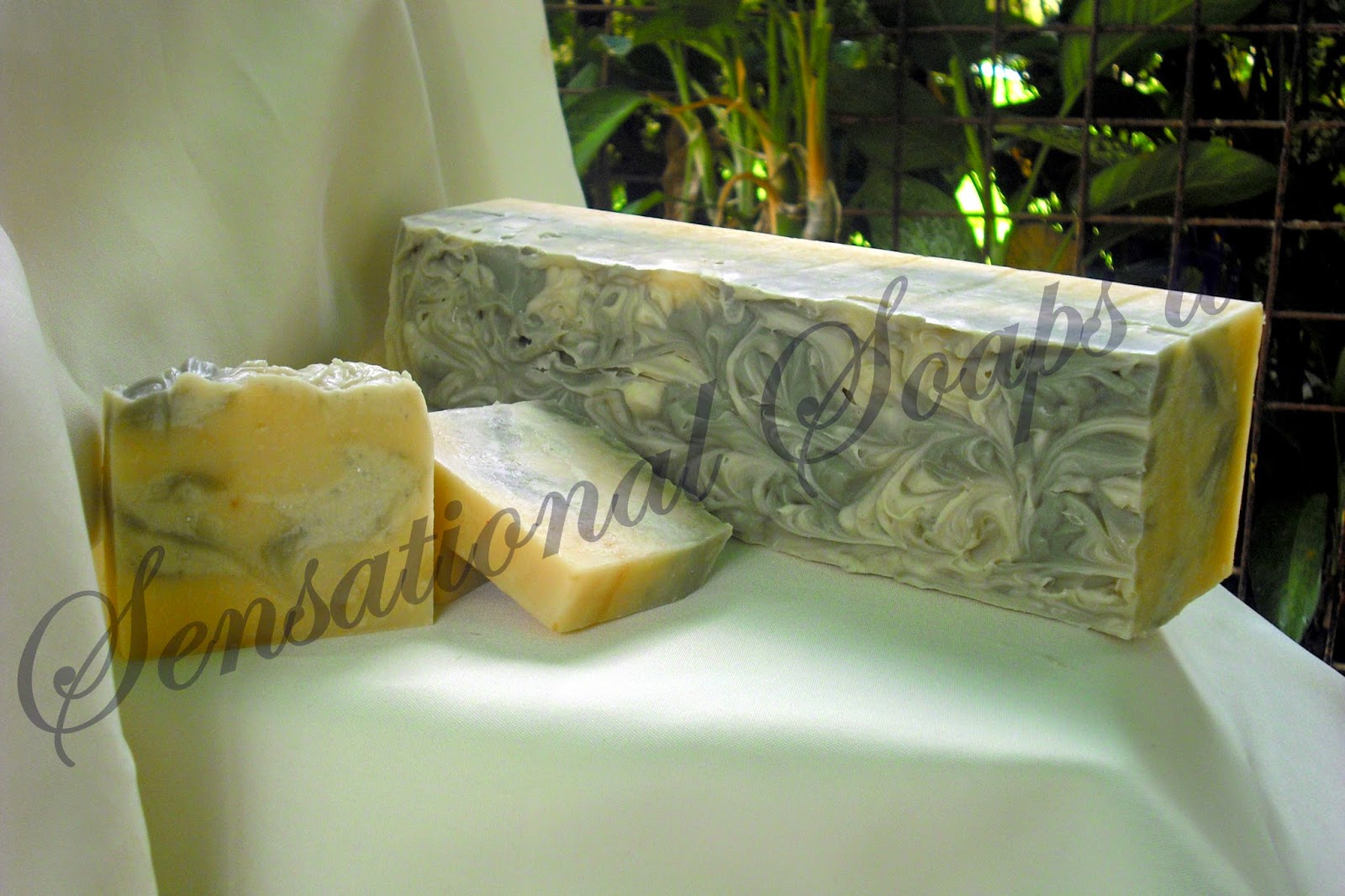
Yesterday I prepared a special order for my dearest cousin. Yes we do special orders. 4lbs of a Eucalyptus and Peppermint Essential oil soap. Wonderfully made with fresh Aloe Vera gel and naturally coloured with Chlorophyll.


One of the things I enjoy about making soap is it's unpredictability. No matter how well we plan there is no knowing how an oil or ingredient would react. This is particularly true of floral essential or fragrance oils. 

In this case the addition of the Aloe Vera gel (even though I've used Aloe Vera in many of my other recipes) resulted in my batch reaching heavy trace (a point of no return where the oils and lye have emulsified and begins to thicken) and some quick thinking.

My planned hanger swirl had been scrapped and was replaced with a simple spoon swirl. Definitely was not disappointed. I don't think my cousin would be either.


This recipe I believe is definitely a keeper and a bar is surely going into the Sensational Soaps Christmas Hamper giveaway.


Thursday, 21 August 2014

Something new

They say patience is a virtue but when it comes to me and soaping it is hard to remain virtuous. In the process of planning purchases and I find myself with an itchy trigger finger. Waiting on supplies time to get creative with what we have on hand.

So what's a girl to do? Well go to the lab and whip up a new recipe. Some Olive oil infused with Rosemary and peppermint, Sweet Almond oil, Coconut oil, Palm oil, Apricot Kernel, Cocoa butter and Pumpkin seed butter. A wonderfully nourishing blend of oils with Coconut milk, fresh Aloe Vera and Noni. Not the recipe that I had in mind when I made the Noni juice Oh. How could I forget the Turmeric.

So what happens when I don't have my base oils. Amazing new recipes!